1. Building Rapport
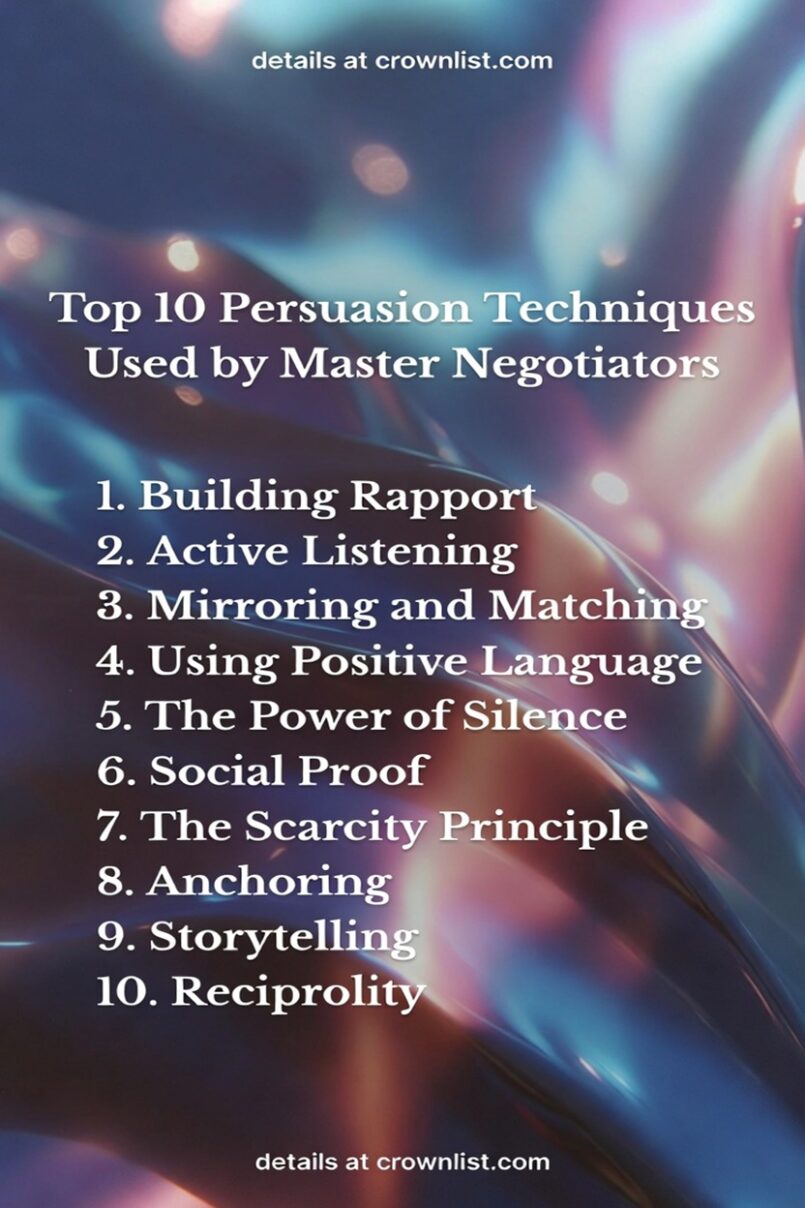
**Building Rapport** is the foundation of every successful negotiation because people are far more likely to be persuaded by someone they like and trust. Master negotiators invest time in genuine connection—through small talk, shared interests, empathy, and warmth—creating an emotional bond that lowers defenses, encourages openness, and makes concessions feel collaborative rather than forced.
2. Active Listening
**Active Listening** ranks second because it is one of the most powerful (and underused) tools in persuasion. By truly hearing the other party—paraphrasing their points, asking clarifying questions, and showing understanding without interruption—negotiators make the other side feel valued and respected, which dramatically increases their willingness to reciprocate, share information, and move toward agreement.
3. Mirroring and Matching
**Mirroring and Matching** works exceptionally well as it taps into subconscious rapport-building through nonverbal and verbal synchronization. Master negotiators subtly copy the other person’s body language, tone, pace of speech, and key phrases, which creates a sense of similarity and comfort (“like attracts like”), making the counterpart feel understood on a deeper level and more open to influence.
4. Using Positive Language
**Using Positive Language** is highly effective because framing statements in affirmative, benefit-oriented terms avoids triggering resistance. Instead of saying “Don’t worry about the price,” a master negotiator says “Imagine the value you’ll get at this price.” Positive phrasing keeps the conversation solution-focused, reduces defensiveness, and directs attention toward mutual gains.
5. The Power of Silence
**The Power of Silence** is a master-level technique because most people feel uncomfortable in quiet moments and rush to fill them—often revealing more information, conceding points, or making offers they hadn’t planned to. Strategic pauses after a question or proposal force the other side to respond first, giving the negotiator control and insight without saying another word.
6. Social Proof
**Social Proof** leverages human psychology that people look to others’ behavior to guide their own decisions. Master negotiators reference how similar parties have accepted the same terms, how industry leaders endorse the approach, or how “most clients in your position choose this option,” creating a bandwagon effect that makes the proposal feel safe, validated, and socially acceptable.
7. The Scarcity Principle
**The Scarcity Principle** drives urgency and increases perceived value. By subtly highlighting limited availability (“This rate is only available until Friday,” or “We only have two slots left at this level”), master negotiators trigger fear of missing out (FOMO), prompting faster decisions and reducing haggling as the other party worries about losing the opportunity.
8. Anchoring
**Anchoring** is one of the most powerful cognitive biases in negotiation. The first number or proposal introduced sets the mental benchmark for the entire discussion. Master negotiators present a strong (often high or low) initial anchor—whether it’s price, terms, or timeline—which pulls all subsequent counteroffers toward that point, even if the final agreement lands somewhere in between.
9. Storytelling
**Storytelling** engages emotions and makes abstract concepts memorable and persuasive. Instead of dry facts, master negotiators share relatable anecdotes, case studies, or personal experiences that illustrate benefits, risks, or outcomes. Stories bypass logical resistance, build empathy, create vivid mental images, and make the negotiator’s position more compelling and human.
10. Reciprocity
**Reciprocity** is a universal social norm: when someone gives something (concession, information, favor, or even a small gift), the other party feels a strong obligation to return the gesture. Master negotiators make the first generous move—offering a concession, sharing valuable insight, or providing a small extra—which creates goodwill and pressures the counterpart to reciprocate, often with larger concessions in return.
These techniques, when combined skillfully, form the core toolkit of elite negotiators across business, sales, diplomacy, and high-stakes deals.