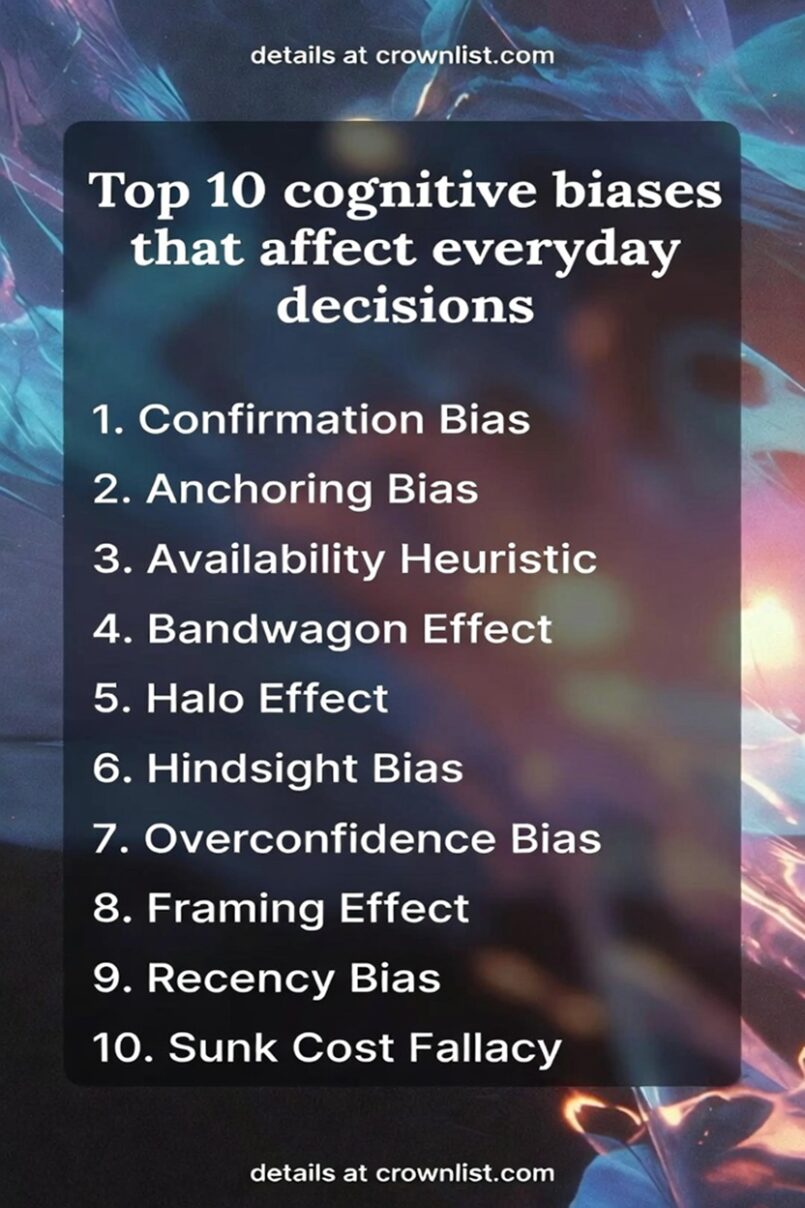
1. Confirmation Bias
We naturally seek out information that supports our existing beliefs while ignoring or downplaying evidence that contradicts them. This bias affects everyday decisions by creating echo chambers in our thinking—whether choosing news sources, evaluating arguments, or making purchases—leading us to reinforce potentially flawed assumptions rather than arriving at more balanced conclusions.
2. Anchoring Bias
The first piece of information we encounter heavily influences subsequent judgments, even if it’s irrelevant. In daily life, this shows up during negotiations, pricing evaluations, or estimations; for example, an initial high price tag can make a slightly lower offer seem like a bargain, skewing our perception of true value.
3. Availability Heuristic
We judge the likelihood of events based on how easily examples come to mind rather than actual statistics. Recent news stories about plane crashes might make flying feel riskier than driving, even though data shows the opposite, causing us to overestimate dramatic but rare risks in routine decisions.
4. Framing Effect
The way information is presented dramatically alters our decisions, even when the underlying facts remain the same. Describing a surgery as having a “90% success rate” versus a “10% failure rate” can lead to very different choices, influencing everyday decisions in marketing, health, and policy preferences.
5. Hindsight Bias
Once an outcome is known, we tend to believe it was predictable or obvious all along (“I knew it would happen”). This “knew-it-all-along” effect distorts learning from past decisions, making us overconfident in future predictions and less critical of our judgment process.
6. Overconfidence Bias
Most people overestimate their own knowledge, abilities, and prediction accuracy. This leads to risky everyday choices—like under-preparing for exams, overinvesting in stocks, or taking unnecessary driving risks—because we consistently believe we’re better than average or more informed than we truly are.
7. Bandwagon Effect
We’re more likely to adopt beliefs or behaviors simply because many others do. Social proof drives decisions in fashion, voting, product reviews, and investments; seeing others rush into a trend often overrides our independent analysis, creating bubbles in markets or popular opinion.
8. Dunning-Kruger Effect
People with limited knowledge or skill in a domain tend to overestimate their competence, while experts may underestimate theirs. This bias affects workplace decisions, debates, and self-assessment, leading novices to make bold claims or choices they’re ill-equipped to handle confidently.
9. Negativity Bias
Negative experiences or information carry more psychological weight than positive ones. We remember criticism more than praise and focus on potential losses over gains, influencing daily choices like avoiding risks, dwelling on failures, or being overly cautious in relationships and opportunities.
10. Status Quo Bias
We prefer things to remain as they are, viewing change as a loss rather than a potential gain. This inertia affects decisions about jobs, investments, relationships, and habits; even when better options exist, the comfort of familiarity often keeps us stuck in suboptimal situations.